
Rodent Proofing And Exclusion In Granite Bay Done Right
Rodent proofing and exclusion in Granite Bay isn’t a one-time patch job. Oak woodland surrounds most neighborhoods here, and roof rats use those branches like a highway straight onto your roofline. We locate every entry point, close it with steel mesh instead of foam, and document the work with photos for owners who travel or manage rentals. If you want rodent exclusion that actually holds through a Granite Bay summer, one call gets you an inspection within 24 to 48 hours.
Call Now For Same Day Inspection
Why Rodent Proofing And Exclusion Matters In Granite Bay Now
Granite Bay’s oak canopy is beautiful and it’s also a rodent superhighway. Branches touch rooflines on almost every older lot, and roof rats travel them without ever touching the ground. Add hot, dry summers that crack cheap sealants, and you get a home with several weak points before you even know it. Homes near Folsom Lake and Miners Ravine see even steadier pressure, since water access keeps rodent numbers high year-round. Trapping alone only removes what’s already inside. Foam and caulk break down fast in this heat and rodents chew through both within days. Real rodent proofing and exclusion means closing the gap permanently, not slowing the problem down for a season.
Roof Rats Versus House Mice In Granite Bay Attics Today Now
Roof rats climb oak branches straight onto tile roofs and nest in attic insulation. House mice stay lower, favoring garages, crawlspaces, and kitchen walls. Both need sealing, but roof rat exclusion always starts at the roofline, not the foundation.
What We Seal During Rodent Exclusion In Granite Bay Homes Now
We inspect and permanently seal every likely rodent entry point on your property, including the spots most homeowners never think to check.
Oak Branch And Tile Roof Entry Points Around Granite Bay Homes
Spanish tile roofs common in Granite Bay often lift slightly at the ridge line, leaving gaps rats squeeze through easily. We flash and mesh these points so they hold under heat expansion.
Our Rodent Proofing And Exclusion Process, Explained Step By Step
Every job follows the same sequence, whether you’re on a quarter acre in The Highlands or a larger lot off Eureka Road. We never seal an active entry point without first confirming that the rodent inside has been removed. That single rule prevents the smell and mess of an animal trapped behind new sealant.
1. Phone triage to understand what you’re hearing and where
2. Full inspection of attic, roofline, foundation, and garage
3. Photo mapping with A/B/C severity ratings for each point
4. Trapping and removal of any active rodents
5. Exclusion work using steel mesh and metal flashing
6. Follow-up checks at 7 and 30 days after the repair
Phase One: Inspection And Species Identification At Your Home
We identify whether you’re dealing with roof rats, house mice, or both, since the entry points and bait strategy differ for each species.
Phase Two: Trapping Before We Seal A Single Entry Point Shut
Trapping always happens before sealing. Closing an active entry point without removing what’s inside creates a bigger problem than the one you started with.
Phase Three: Exclusion, Sanitation, And Final Verification Here
Once sealing is complete, we HEPA vacuum any nesting material and apply enzyme deodorizer to remove scent trails that attract the next generation..
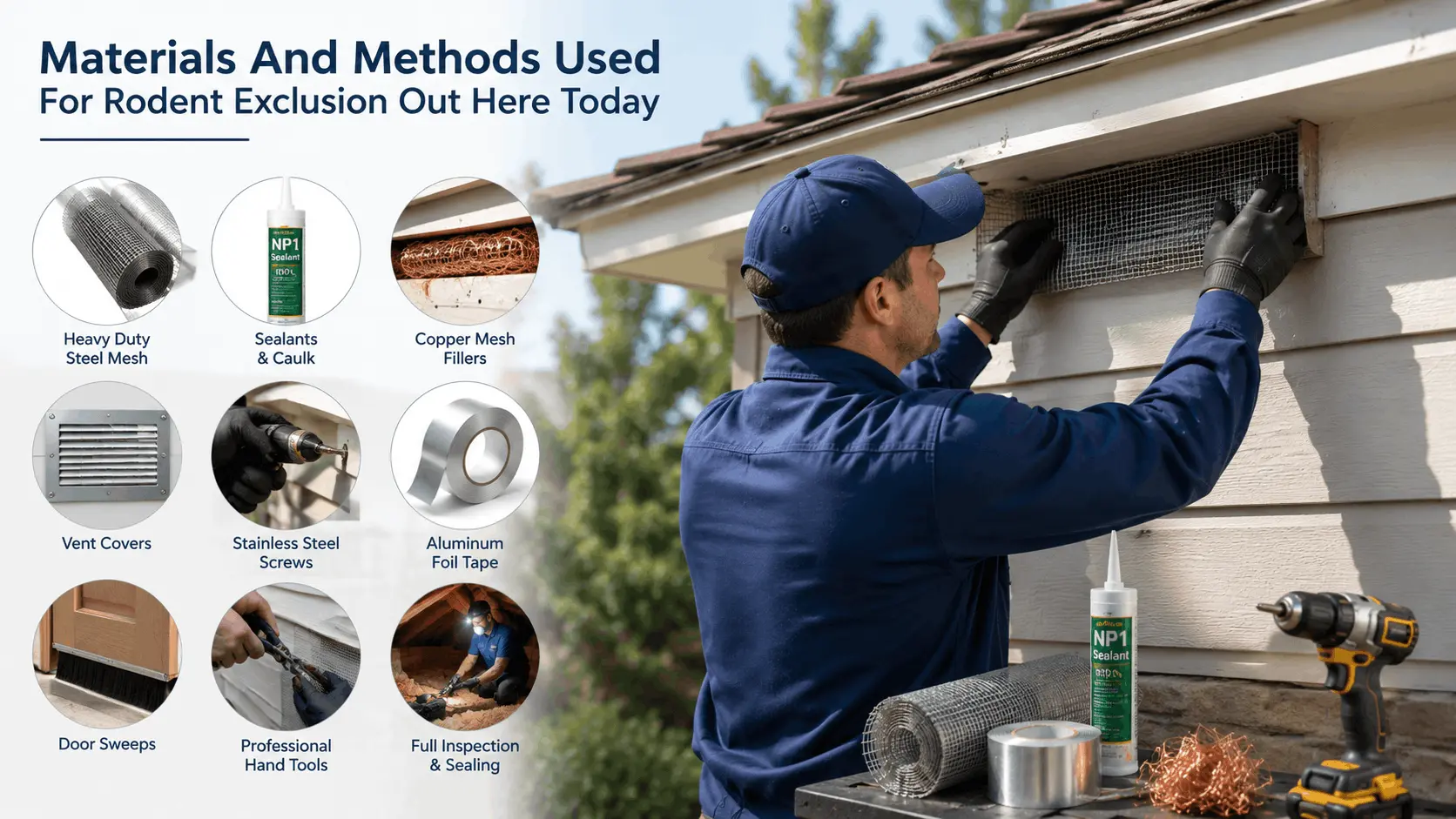
Materials And Methods Used For Rodent Exclusion Out Here Today
Granite Bay summers regularly top 100 degrees, and that heat breaks down cheap sealants within a season. We use quarter-inch stainless steel hardware cloth, galvanized flashing, and heat-rated vent guards on every job. Recessed, tamper-resistant fasteners keep rodents from gaining leverage to chew through the edges of a repair.
Why Foam And Caulk Fail As Rodent Exclusion Materials Here Fast
Foam softens in summer heat, and both rats and mice chew through it within days. Caulk cracks under thermal expansion on tile and stucco. Neither material was built to stop a determined rodent.
Rodent Exclusion Pricing And Transparency In Granite Bay, CA
You should see a price range before anyone steps onto your property. Here’s what most Granite Bay customers pay based on recent jobs across Placer County.
|
Service |
Typical Cost |
What’s Included |
|---|---|---|
|
Inspection & Report |
$325 |
Credited toward exclusion work |
|
Trapping Program (7–10 days) |
$475 |
Humane live-catch removal |
|
Standard Exclusion |
$250–$4,200 |
Most Granite Bay single-story home |
|
Complex Exclusion |
$1,000–$8,000+ |
Larger homes, barns, or multi-level lots |
|
Attic Cleanup |
$700–$5,000 |
Priced by contamination leve |
What Changes Your Rodent Exclusion Cost Estimate Overall Here
Roof pitch, tile versus composition shingle, and the number of oak trees touching the structure all affect the final price more than square footage alone.
Rodent Proofing For Granite Bay Ranch And Lake Properties Now
Larger Granite Bay properties often include barns, chicken coops, or feed storage, and each of those structures needs its own exclusion plan. Grain and feed draw rodents from the surrounding oak woodland faster than almost anything else on a property. We treat outbuildings as separate zones from the main house, since rodents travel between structures along fence lines and irrigation trenches.
Rodent Proofing Options For Barns, Coops, And Feed Rooms Nearby
We seal feed rooms first, then work outward toward the house, closing every gap a rodent could use as a travel corridor between structures.
What We Document During Every Rodent Exclusion Visit Here Today
Every visit ends with proof, not a verbal promise you have to remember.
Real feedback: “They caught the gap behind our chimney flashing two other companies missed. Nothing’s come back since.” — Marcus T., Winding Creek
Frequently Asked Questions
What is included in rodent proofing and exclusion service?
It includes a full inspection, trapping of active rodents, sealing every entry point with steel mesh and metal flashing, and a follow-up check to confirm the repairs are holding.
How much does rodent exclusion cost in Granite Bay, CA?
Most homeowners pay between $325 for an inspection and $4,200 for full exclusion, depending on roof type and how many entry points we find. Barns and larger lots run higher.
How long does rodent proofing and exclusion take to complete?
Most attic jobs clear within 5 to 10 days once traps sit in the right travel corridors. Severe colonies near oak canopy cover can take up to two weeks.
Will rodents chew through steel mesh exclusion repairs?
No. Quarter-inch stainless steel mesh resists chewing from both rats and mice, which is why it holds up far longer than foam, caulk, or basic screening.